
When we’re talking about feeling and love, what lies beneath the words 'I Love You' sometimes - well, most of the time - refers to different and various feelings. We will have different feelings if the words are said through chats or virtually, and it will lead to another different meaning or feeling if it is said on an intimate dinner with loved ones. The experience of saying the words is the principal key to whether it will succeed in making people delighted or miserable.
Same goes with brands. To tell the target market about the values or messages, brands create various interactions. The market and the customers will have different experiences or even feelings that trigger them to decide “We belong to each other and I will be loyal to you”. Those experiences are known as Brand Experience.
Brand Experience is any kind of experience produced by various interactions between the customers with the brands so that the relations become stronger and closer. The Brand Experience is aimed to build perceptions and associations of the customers toward brands. There are four experience dimensions created when the brands succeed building interactions for their customers.
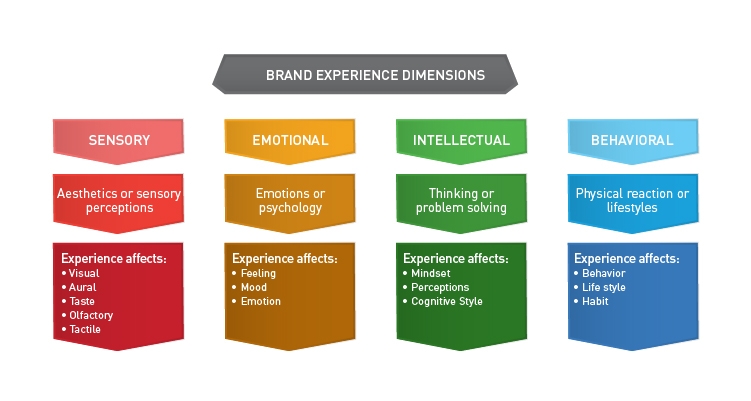
Those various experiences happen since the customers encounter, search for, shop for, buy and experience services, until they use and consume products. In those journeys, brands create interactions. To create interactions that are appealing to the target market, brands build various Brand Touchpoints.
However, not all touchpoints can produce good interactions. Brands need to adjust touch points so that the customers are able to interact with the brands in a good way and have a good experience that are not only close or connected but also related to them from time to time.
In 2009, Amitava Chattopadhyay dan Jean-Louis Laborie developed a concept called Contact Clout Factor in Journal of Advertising Research entitled 'Managing Brand Experience: The Market Contact Audit'. They provide three concepts to evaluate brand touchpoints.
- Expertise: called as Information Value
- Attractiveness: called as Attractiveness Value
- Honesty: called as Power
The explanations of those three concepts are below:
1. Expertise
Expertise is conceptualised as the ability of a touchpoint in delivering the relevant information. Brand owners need to continuously update and renew the brand touchpoints based on whether the information delivered is relevant with the target market.
2. Attractiveness
Attractiveness is conceptualised as the ability of a touchpoint to make their target market interested and attracted to the brands. Each touchpoint needs to portray the brand in an emotionally attractive and appealing way.
3. Honesty
Honesty is conceptualised as the ability of a touchpoint to influence the customers' buying decision through message acceptance. Brand owners need to evaluate the touchpoints based on whether the message and value of the brand is delivered so that it can influence the customers to purchase.
Markets will always change. Brands need to evaluate any kinds of touchpoints that they have created to be always close and related to their target market through interactions. With the continuously adjusted touchpoints, brands are able to attract their target market.
There are so many kinds of touchpoints. basicludo are supporting brand owners to build appealing and attractive touch points so that the target market can comfortably interact with brands and have Brand Experiences that are connected and related to them.
Source:
Amitava Chattopadhyay and Jean-Louis Laborie (2005). Managing Brand Experience: The Market Contact AuditTM. Journal of Advertising Research, 45, pp 9-16.
Arthur Cheng-Hsui Chen Shaw K. Chen Chien-Lin Ma . "Brand Experience and Customer Equity Prediction" In Advances in Business and Management Forecasting. Published online: 14 Jul 2016; 19-38.
Walter, Nadine and Cleff, Thomas and Lin, Chun, Can You Feel it? – the Effect of Brand Experience on Brand Equity (December 8, 2014). The IUP Journal of Brand Management, Vol. XI, No. 2, June 2014, pp. 7-27.